Physics & findings
The lab you just used is driven by a physics engine built from the real device — the
{12/5} winding, the EFH1 ferrofluid, and the slug's driven dynamics. Here's what's under it and
what it found. Full provenance: docs/SPEC.md in the repo.
The device
A ~3.5″ printed torus with a 1″ tube holds a sealed raceway full of ferrofluid and one free
~12.7 mm N52 slug — axially magnetized, its N–S axis lying tangent to the track. One
copper conductor is sewn in a {12/5} star (12 nodes, each stitch skipping 5, through the
bore and around the tube), giving 12 poloidal turns and 5 bore-axis encirclements per wrap. A
stereo amp drives L = 314 Hz and R = 3140 Hz into the two ends, so the coil sees
L − R. The half-covered winding rectifies that differential drive into a one-way
orbit whose speed is set by volume; it melts at volume 6.
What the engine found
- Biot–Savart field solver validated to 4×10⁻⁶ against the analytic loop. Bore field scales linearly with wrap count — more wraps, stronger field, faster slug (1 wrap = dead).
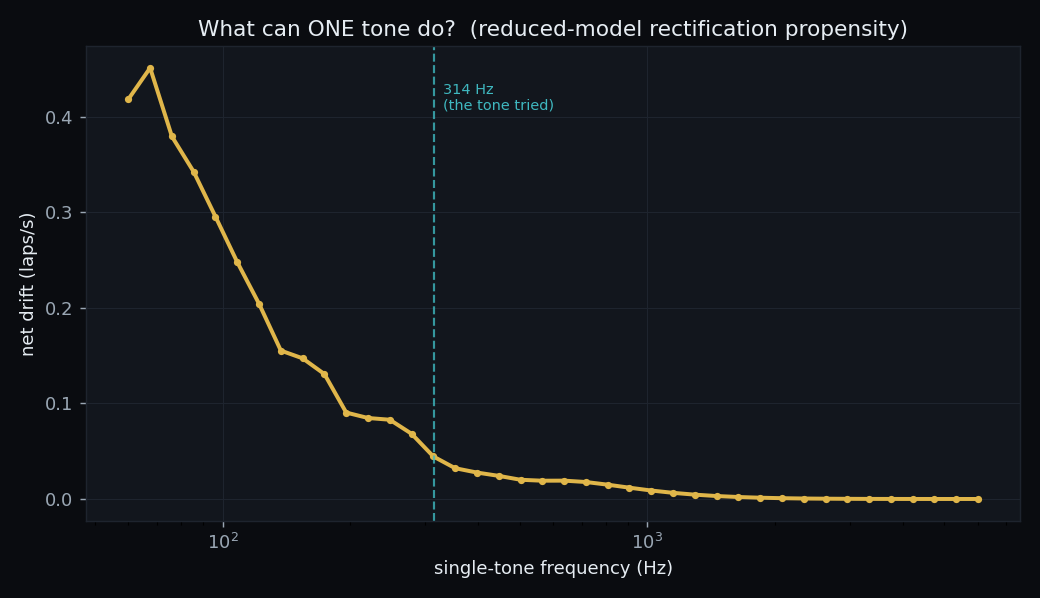
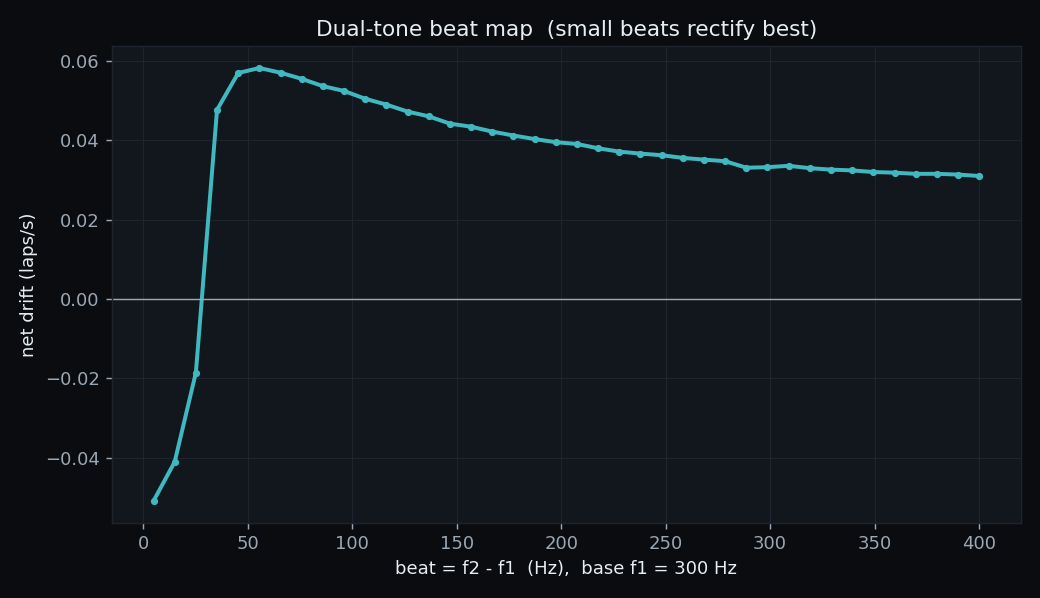
- The {12/5} landscape is nearly reflection-symmetric, so a single tone barely rectifies from the winding alone — which is why frequency and the ferrofluid matter so much.
- Bulk fluid flow rigorously cannot drive the orbit: for a single winding the net azimuthal Kelvin force integrates to zero (verified to 10⁻¹²). The driver is the direct force on the slug, rectified by the ~50% coverage asymmetry.
- EFH1's larger particles relax at 4–6.5 kHz — right at the 3140 Hz tone — which is why that specific pair is a live operating point.
Bench predictions worth testing
| Prediction | From |
|---|---|
| A single low tone (~60 Hz) should move the slug better than a ~314 Hz tone did | single-tone sweep |
| Feeding both channels the same tone (L = R) kills all motion | differential null |
| More wraps → faster; a single wrap won't start | field ∝ wraps |
| Two devices bore-to-bore with one magnet inverted counter-rotate and repel | polarity flip |
built with Claude Code · ← the lab